Monday, 25 July 2011

Indian God Durga

represents the power of the Supreme Being that preserves moral order and righteousness in the creation. The Sanskrit word Durga means a fort or a place that is protected and thus difficult to reach. Durga, also called Divine Mother, protects mankind from evil and misery by destroying evil forces such as selfishness, jealousy, prejudice, hatred, anger, and ego.
The worship of Goddess Durga is very popular among Hindus. She is also called by many other names, such as Parvati, Ambika, and Kali In the form of Parvati, She is known as the divine spouse of Lord Shiva and is the mother of Her two sons, Ganesha and Karttikeya, and daughter Jyoti. There are many temples dedicated to Durga's worship in India.
In Her images, Goddess Durga is shown in a female form, wearing red clothes. She has eighteen arms, carrying many objects in Her hands. The red color symbolizes action and the red clothes signify that She is always busy destroying evil and protecting mankind from pain and suffering caused by evil forces. Following is the symbolism associated with Goddess Durga


  • A tiger symbolizes unlimited power. Durga riding a tiger indicates that She possesses unlimited power and uses it to protect virtue and destroy evil. The eighteen arms of Durga signify that She possesses combined power of the nine incarnations of Lord Vishnu that have appeared on the earth at different times in the past. The tenth incarnation, the Kalkin (a man on a white horse), is still to come. Thus, Goddess Durga represents a united front of all Divine forces against the negative forces of evil and wickedness.
  • The sound that emanates from a conch is the sound of the sacred syllable AUM, which is said to be the sound of creation. A conch in one of the Goddess's hands signifies the ultimate victory of virtue over evil and righteousness over unrighteousness.
  • Other weapons in the hands of Durga such as a mace, sword, disc, arrow, and trident convey the idea that one weapon cannot destroy all different kinds of enemies. Different weapons must be used to fight enemies depending upon the circumstances. For example, selfishness must be destroyed by detachment, jealousy by desirelessness, prejudice by self-knowledge, and ego by discrimination.

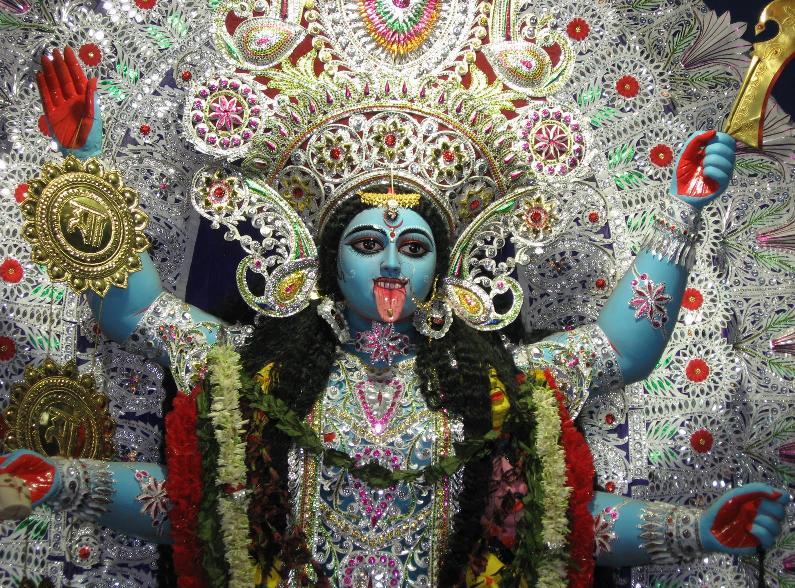
Indian God Kali

Kali comes from the Sanskrit root word Kal which means time. There is nothing that escapes the all-consuming march of time. In Tibetan Buddhism Her counterpart is male with the name Kala. Mother Kali is the most misunderstood of the Hindu goddesses. The Encyclopedia Britannica is grossly mistaken in the following quote, "Major Hindu goddess whose iconography, cult, and mythology commonly associate her with death, sexuality, violence, and, paradoxically in some of her later historical appearances, motherly love."

It is partly correct to say Kali is a goddess of death but She brings the death of the ego as the illusory self-centered view of reality. Nowhere in the Hindu stories is She seen killing anything but demons nor is She associated specifically with the process of human dying like the Hindu god Yama (who really is the god of death). It is true that both Kali and Shiva are said to inhabit cremation grounds and devotees often go to these places to meditate. This is not to worship death but rather it is to overcome the I-am-the-body idea by reinforcing the awareness that the body is a temporary condition. Shiva and Kali are said to inhabit these places because it is our attachment to the body that gives rise to the ego. Shiva and Kali grant liberation by removing the illusion of the ego. Thus we are the eternal I AM and not the body. This is underscored by the scene of the cremation grounds.

Of all the forms of Devi, She is the most compassionate because She provides moksha or liberation to Her children. She is the counterpart of Shiva the destroyer. They are the destroyers of unreality. The ego sees Mother Kali and trembles with fear because the ego sees in Her its own eventual demise. A person who is attached to his or her ego will not be receptive to Mother Kali and she will appear in a fearsome form. A mature soul who engages in spiritual practice to remove the illusion of the ego sees Mother Kali as very sweet, affectionate, and overflowing with incomprehensible love for Her children.

Ma Kali wears a garland of skulls and a skirt of dismembered arms because the ego arises out of identification with the body. In truth we are beings of spirit and not flesh. So liberation can only proceed when our attachment to the body ends. Thus the garland and skirt are trophies worn by Her to symbolize having liberated Her children from attachment to the limited body. She holds a sword and a freshly severed head dripping blood. As the story goes, this represents a great battle in which she destroyed the demon Raktabija. Her black skin represents the womb of the quantum unmanifest from which all of creation arises and into which all of creation will eventually dissolve. She is depicted as standing on Shiva who lays beneath Her with white skin (in contrast to Her black or sometimes dark blue skin). He has a blissful detached look. Shiva represents pure formless awareness sat-chit-ananda (being-consciousness-bliss) while She represents "form" eternally supported by the substratum of pure awareness.


By not understanding the story behind Mother Kali it is easy to misinterpret Her iconography. In the same way one could say that Christianity is a religion of death, destruction and cannibalism in which the practitioners drink the blood of Jesus and eat his flesh. Of course, we know this is not the proper understanding of the communion ritual.

Attaching the idea of sexuality to Mother Kali has no basis in Her at all. There is nothing that associates Her with sexuality in the Hindu stories. In fact it is just the opposite. She is one of the few Goddesses who is celibate practicing austerity and renunciation!

Indian God Lakshmi


Draped in a red saree, bedecked with gold ornaments, seated on a lotus, pot in hand, flanked by white elephants, the image of Lakshmi adorns most Hindu homes and business establishments.

Lakshmi, also called Laxmi, is the goddess of wealth, fortune, power, luxury, beauty, fertility, and auspiciousness.  She holds the promise of material fulfillment and contentment.  She is described as restless, whimsical yet maternal, with her arms raised to bless and to grant her blessings.

Shri is the sacred name of Lakshmi.  Shri is written atop most documents and spoken before addressing a god, teacher holy man or any revered individual.  The word evokes grace, affluence abundance, auspiciousness and authority.  When the word is spoken or written an aura of holiness is established.  Whatever follows is imbued with divine blessing.  Just as the word “Om” is associated with the mystical side of life, Shri is associated with the material side of existence.

Lakshmi represents the beautiful and bountiful aspect of nature.  As Bhoodevi, the earth-goddess, she nurtures life; as Shreedevi, the goddess of fortune, she bestows power, pleasure and prosperity on those who deserve her grace.  To realize her, one must respect the laws of life and appreciate the wonders of existence.


In the beginning, there was water everywhere.  There was nothing to eat and nowhere to live.  Prajapati, the divine patriarch, father of the gods and demons saw the plight of his children and invoked Devi.
 
The goddess whispered into his ear, “The earth lies trapped under the water.  Raise it up.”
 
Prajapati took the form of a mighty boar called Emusha, plunged into the sea and found the earth-goddess Bhoodevi on the ocean floor.  Placing her on his snout, he gently raised her to the surface.
 
Prajapati then turned into Akupara, a giant turtle and offered Bhoodevi a seat on his back.

Indian God Brahma

Brahma is considered the creator of the universe. Before the cosmos existed, Brahma was all alone, self contained and self-content. Eventually, he felt inadequate and longed for company. Brahma split himself and created the goddess Shatarupa. Her many forms captivated Brahma, and he desired to posses her.

But that was not to be. Like all material things, Shatarupa would turn into something else every time Brahma got to her. She turned into a cow, a mare, a goose and a doe. Lord Brahma kept pursuing her, taking the form of the corresponding male - a bull, a horse, a gander, a buck. Thus all creatures of the cosmos, from the smallest insect to the largest mammal, came into being.

The Hindu God Brahma sprouted five heads, so that he could watch Shatarupa at all times. To restrain Brahma's lust, Shivawrenched off one of Brahma's five heads. This helped Brahma come to his senses, and he took Saraswati, the goddess of knowledge, as his consort. With her help, he regained control of his mind.

For creating the universe, Brahma became known as the lord of progeny. But he is not worshipped because he is responsible for distracting the mind away from the soul and towards the cravings of the flesh. However, you will see shrines dedicated to Brahma on the grounds of buildings. A very famous shrine is on the grounds of the Erawan Hotel in Bangkok, and people to make offerings to Brahma there, such as hiring musicians and dancers to perform for him.


Brahma the Trouble Maker

From time to time in religious texts, Lord Brahma appears to aid the side of chaos. In the Mahabharata, for example, Brahma provides a magic arrow to the enemies of Arjuna. It then seems that the Hindu Gods spend a significant amount of time helping to defeat those who have benefited from Brahma's misdeeds, as opposed to fighting the God Brahma himself. On the other hand, usually when Brahma helps an adversary, the heroes learn an important lesson, or make a realization that they wouldn't have if Lord Brahma had not meddled in the first place.

Brahma Not The Creator of The Universe After All?

One interesting aspect of different creation stories is that sometimes Vishnu or Shiva are given credit for creating the world. It is believed that they dreamed up the creation of the universe, with Brahma doing all the heavy lifting in the dream, as if he were just following the blueprints laid out by the other two gods.

Brahma's Pose and Hand Gestures

Unlike most Hindu Gods Brahma is not depicted with weapons. Instead, he is shown holding prayer beads, a water vase, and a book, symbolizing the Vedas (the original Hindu religious texts). It is said that Brahmas four mouths constantly recite the four Vedas. Brahma's fourth hand is sometimes shown holding a lotus blossom, and sometimes shown holding a staff.

Krishna Shiva

We are very beginning from the birthplace of  lord Krishna. Mathura is the birthplace of lord Krishna. The city of Mathura is located in the western part of the state of Uttar Pradesh, in the northern region of India. It is situated on the bank of the river Yamuna. Mathura is 150 km south of Delhi and 50 km northwest of Agra.

Mathura is also knows as Brij Bhoomi - The land where Shri Krishna was born and spent his youth. It is an important pilgrim place of the Hindus and one of the seven sacred cities in India. The main pilgrim center in Mathura is the Shri Krishna Janmabhoomi temple. Krishna is the Supreme Person. Lord Krishna appeared over five thousand years ago in Mathura, India to Devaki and Vasudeva in the jail cell of the tyrant Kansa. The place of His birth is known as Sri Krishna Janmasthana.

You can get the detailed information about lord Krishna such as History of lord Krishna, About radha rani, radha krishna hidu god, hindu gods, About Mathura-Vrindavan, Real Picture and Photo's of Lord Krishna


One of the many complexities about the God Shiva is his role as a head of household. According to different sources, he has several wives, with the major Hindu Goddess Parvati being one of them, and the lesser Hindu Goddess Ganga being another. While the majority of stories detailing the Shiva's romantic side deal primarily with his relationship with Parvati, he is also respected for his willingness to throw himself at the feet of another consort, the Goddess Kali in order to stop her blood thirsty rampage of destruction. As for his offspring, One of his sons, Ganesh, is the elephant headed god of success who is recognized and worshipped nearly universally throughout Hindu India. Another son, Skanda, is worshipped primarily in Southern India.

Rama Indian God

Lord Rama
Lord Rama is known as the seventh incarnation of Lord Vishnu. Rama, the perfect avatar of the Supreme Protector Vishnu, has always been popular among the Hindu deities. Rama is the symbol of courtesy and virtue, a man of values and morals. Ramachandra is Maryada Purushottama, which means the perfect man. Lord Rama is considered to have taken birth on the earth to destroy the evil forces of the age.

Lord Rama, in the words of Swami Vivekananda, is "the embodiment of truth, of morality, the ideal son, the ideal husband, and above all, the ideal king". Rama is widely accepted to be an actual historical figure - a "tribal hero of ancient India" - whose deeds form the great Hindu epic of Ramayana or The Romance of Rama, written by the ancient Sanskrit poet Valmiki. According to the Hindus belief, Rama lived in the Treta Yug. Although historians are of the conviction that Rama was not particularly deified until the 11th century AD. Tulsidas' wonderful version of the Sanskrit epic "Ramayana" into "Ramcharitmanas" greatly enhanced the popularity of Rama as a Hindu god and gave rise to various devotional groups. 


Virtues of Rama
Shri Rama was a paragon of virtues. Rama was not only kind and affectionate but generous and considerate of feelings for all around him. Lord Rama had a marvelous physique and captivating manners. Shri Ram had a magnanimous personality. He was extremely noble, generous, chivalrous and fearless. He was very simple and absolutely free from flamboyance.

Lord Rama is considered as a son unequalled in the world, and resembled Dasaratha in each and every aspect of good qualities. He never spoke a lie throughout his life. He always offered respect to the scholars and the elders, people loved him and he adored the people. His body was transcendental and outstanding. He was eloquent, attractive and adjustable to circumstances. He knew the heart of each and every human being on the earth (being omniscient). He had all the conceivable qualities of a king's son and was dear to the people as their own hearts.

Lord Rama was endowed with incredible transcendental qualities. The earth personified adored him, who was possessor of such virtues, who was indomitable, who was brave, and who was the unequalled Lord of all. To put succinctly, Sri Rama's life was a life of holy compliance, of stainless purity, of matchless simplicity, praiseworthy contentment, commendable self-sacrifice and remarkable renunciation. 

Krishna Indian God

As a youth, the cowherd Krishna became renown as a lover, the sound of his flute prompting gopis (wives and daughters of the cowherds) to leave their homes to dance ecstatically with him in the forests.The child Krishna was adored for his mischievous pranks; he also performed many miracles and slew demons.  His favorite among the daughters of the cow herders  was the beautiful Radha.  Krishna's youthful dalliances with the gopis are interpreted as symbolic of the loving interplay between God and the human soul.Krishna affirms life in his pranks, music and lovemaking
e rich variety of legends associated withKrishna's life led to an abundance of representation in painting and sculpture.  The divine lover (the most common representation) is shown playing the flute, surrounded by adoring gopis

Arjuna sat dejected, filled with pity, his sad eyes blurred by tears.  Krishna gave him counsel.
Why this cowardice in time of crisis, Arjuna?  The coward is ignoble, shameful, foreign to the ways of heaven.
Don't yield to impotence!  It is unnatural in you!  Banish this petty weakness from your heart.  Rise to the fight, Arjuna!
Arjuna
Krishna, how can I fight against Bhishma and Drona with arrows when they deserve my worship?  It is better in this world to beg for scraps of food than to eat meals smeared with the blood of elders I killed at the height of their power while their goals were still desires.


Krishna and the Serpent Kaliya
Lord Krishna came to know that a very large and poisonous serpent had made its home in a lagoon on the Yamuna river. Because the serpent was so poisonous, not only all the fish died, but even the trees and grass surrounding the lake were dying. When birds flew over the area, they immediately dropped dead and fell into the lake, due to the highly poisonous vapors emanating from the water.

In that time, there were many frightful demons, who had all kinds of mystic powers. Lord Krishna had specifically appeared to rid the world of all these disturbing elements. The Lord came to this place with His cowherd boyfriends and decided to confront the king of the snakes. He climbed the large Kadamba tree and from there, jumped into the poisonous waters of the Yamuna.

Lord Krishna then began splashing about and making very loud noises just to disturb the Kaliya serpent. Sure enough, the Kaliya snake came up to the surface to see who was attacking his home. This huge black serpent Kaliya (Kaliya means black) possessed over one hundred hoods, each bedecked with a precious gem. When he breathed, fire emanated from his nostrils. He suddenly seized Krishna in his powerful coils, and bound the Lord as tightly as possible. But unfortunately this serpent did not realize that within its coils was the Supreme Personality of Godhead, playing as a child and enjoying His earthly pastimes in the transcendental land of Vrindavana. Without warning, Krishna, the Supreme Mystic, started to expand His body, and Kaliya, who began to feel the incredible pressure, was forced to release the Lord from his deadly coils. Krishna then jumped on to the hoods of the great serpent and started to dance, stamping His foot down on the heads of the snake demon, Kaliya.

This stamping of Krishna, felt to 
Kaliya serpent like Indra's thunderbolt striking a mountain. The Lord jumped from one hood to another, and Kaliyafelt helpless and bewildered; in anger he spat fire from his many mouths but the Lord was so dexterous that His dancing movements caused the-snake to become dizzy. After so many kicks from the Lord, Kaliya started to first vomit blood, and then refuse, before becoming almost unconscious. At that time, the many wives of the Kaliya serpent appeared and begged the Lord with folded hands to spare their husband. Krishnadecided to banish Kaliya to the great ocean never to return again. Thereafter, the giant snake along with his wives, departed forever, and the transcendental Lord re-joined His cowherd boyfriends on the bank of the Yamuna, to continue their wonderful pastimes in the land of Vrindavana.